
Organize the journey, documentation and context across consultations.
HEALTHCARE / HEALTHTECH
Work area · active evolutionData, AI and product to make healthcare complexity understandable.
I design systems that help organize complex information, connect longitudinal follow-up and turn real needs from patients, families and professionals into useful digital products.
01 · THESIS
They are not isolated projects. They are a consistent way of working.
The projects start from different contexts, but share the same pattern: understand complexity, structure information, preserve context and build the right tool for the people who need to use it.
Connect sources, research, hypotheses and follow-up.
Design around the real workflow and decision context.
One approach applied from different perspectives: patient and family · knowledge · healthcare professional.
02 · CASES
Four pieces. Four distinct roles.
Each case demonstrates a different part of the HealthTech capability. This overview explains the map; the Deep Dives show the method and execution in depth.
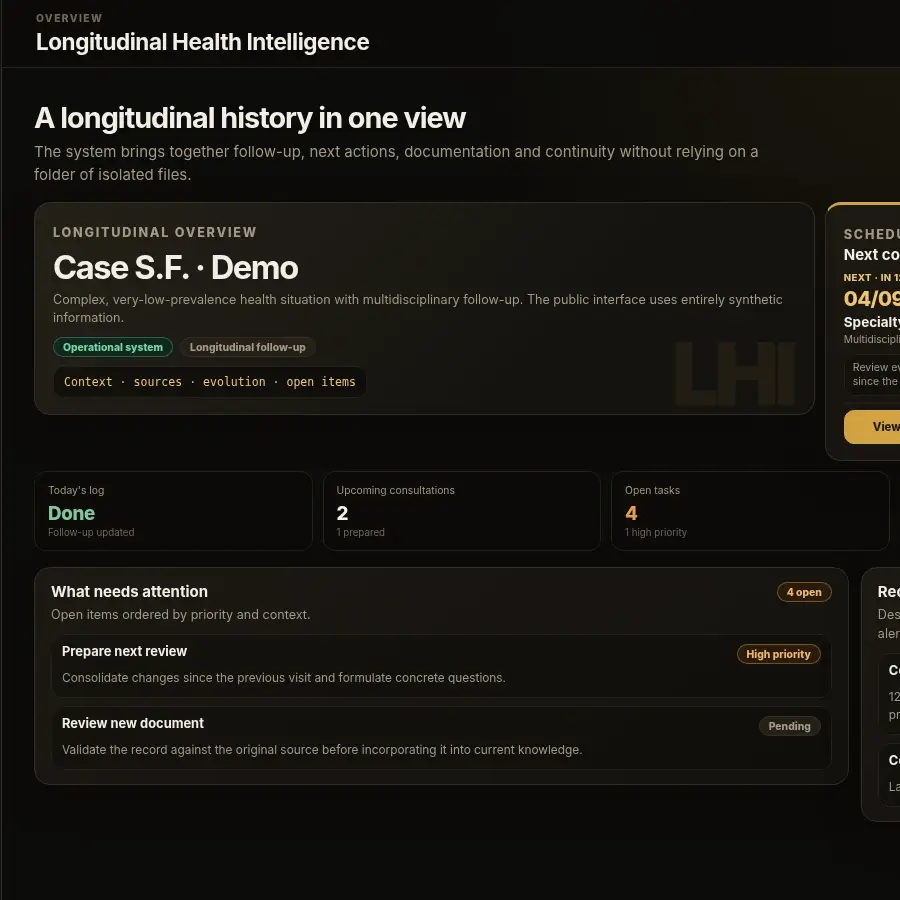
Longitudinal Health Intelligence
A longitudinal system that turns research, documentation, follow-up and the consultation cycle into a knowledge architecture that can be preserved and used.
Longitudinal Data · Knowledge Systems · Product · Responsible AI
View Deep Dive →
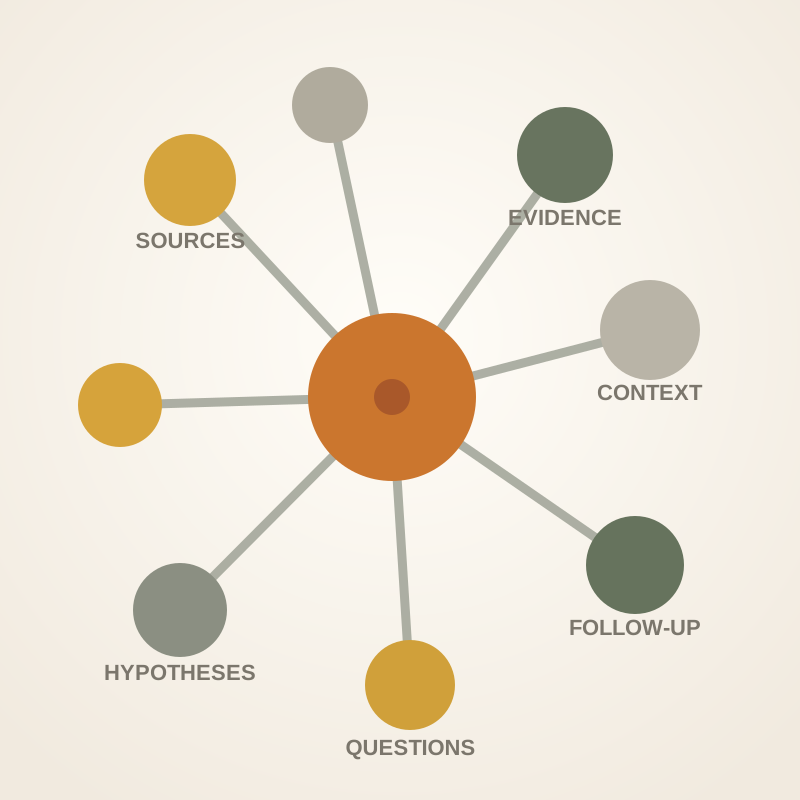
Project S.F.
Longitudinal research on a complex clinical case: scientific sources, evidence mapping, explicit separation of facts and hypotheses, and questions prepared for professional review.
Research · Evidence Mapping · Longitudinal Analysis · Knowledge Architecture
View Deep Dive →

EchoFather Familias
A social-impact initiative that helps families organize information, preserve continuity and arrive better prepared for their interactions with the healthcare system.
Family Coordination · Continuity · Context · Responsible Use
View Deep Dive →
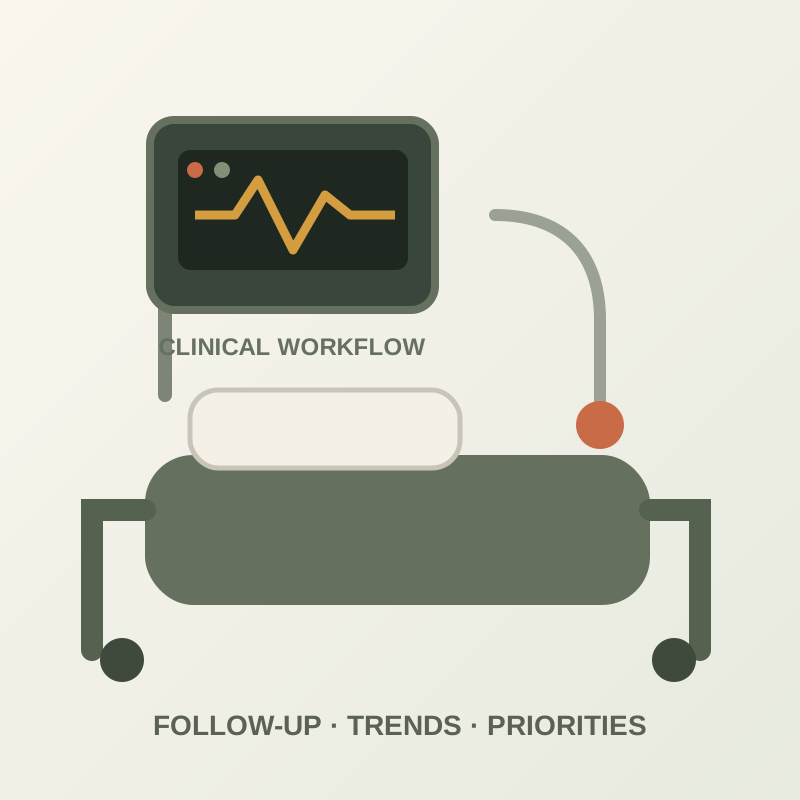
Clinical
A clinical tool designed from real needs in an intensive care unit to structure follow-up, trends and care-team priorities.
Discovery · Clinical Workflow · Data Visualization · Product Design
View Deep Dive →
03 · FROM PROBLEM TO PRODUCT
Technology starts after understanding how people actually work.
The common pattern does not start with a specific technology. It starts with the problem, the context and the person who needs to understand, decide or act on the information.
Understand
Problem, context, users, decisions and real friction.
Structure
Turn documents, processes and data into a usable architecture.
Build
Product, automation, visualization or applied intelligence.
Measure
Evaluate use, outcomes, learning and the next iteration.
PRINCIPLEAI can be part of the solution. It does not need to be the product.
04 · CAPABILITIES
HealthTech connects professional experience with concrete healthcare problems.
Data, research, product and automation combine according to the problem. The transversal capability is translating complexity into a structure that can be used and evolved.
Data & Analytics
Modelling, longitudinal analysis, KPIs, trends and visualization.
Research & Evidence
Sources, evidence mapping, explicit hypothesis separation and traceability.
AI & Knowledge Systems
Contextual search, document synthesis and knowledge-based systems.
Product & UX
Functional design based on real user needs.
Automation
Transforming manual processes into maintainable digital workflows.
Privacy by Design
Minimization, access, separation, authorization and traceability by design.
05 · RELEVANCE OF THE APPROACH
From specific cases to information patterns that recur across different contexts.
The cases reveal recurring patterns: longitudinal information, fragmented processes, complex documentation and tasks that still rely too heavily on manual tools.
The case may be exceptional. The information problem is not.
The goal is not to multiply technology. It is to build clarity where complexity exists today.