
Distributed information
Reports, tests, consultations, notes and external sources describe different parts of the same story.
LONGITUDINAL HEALTH INTELLIGENCE
Private system · Operational and evolvingA private longitudinal system designed to organize complex clinical information, research and follow-up over time, preserve context between consultations and turn fragmented documentation into usable knowledge.
01 · STARTING POINT
When a health situation extends over years and involves different professionals, the challenge is not simply preserving files. It is knowing what happened, what changed, what remains open and which information supports each conclusion.
Reports, tests, consultations, notes and external sources describe different parts of the same story.
Each document preserves a moment; understanding evolution requires connecting moments that are separated in time.
Facts, external evidence, possible associations and hypotheses should not carry the same weight.
Each new consultation can force the reconstruction of context that had already been worked through.
02 · RESEARCH AND EVIDENCE
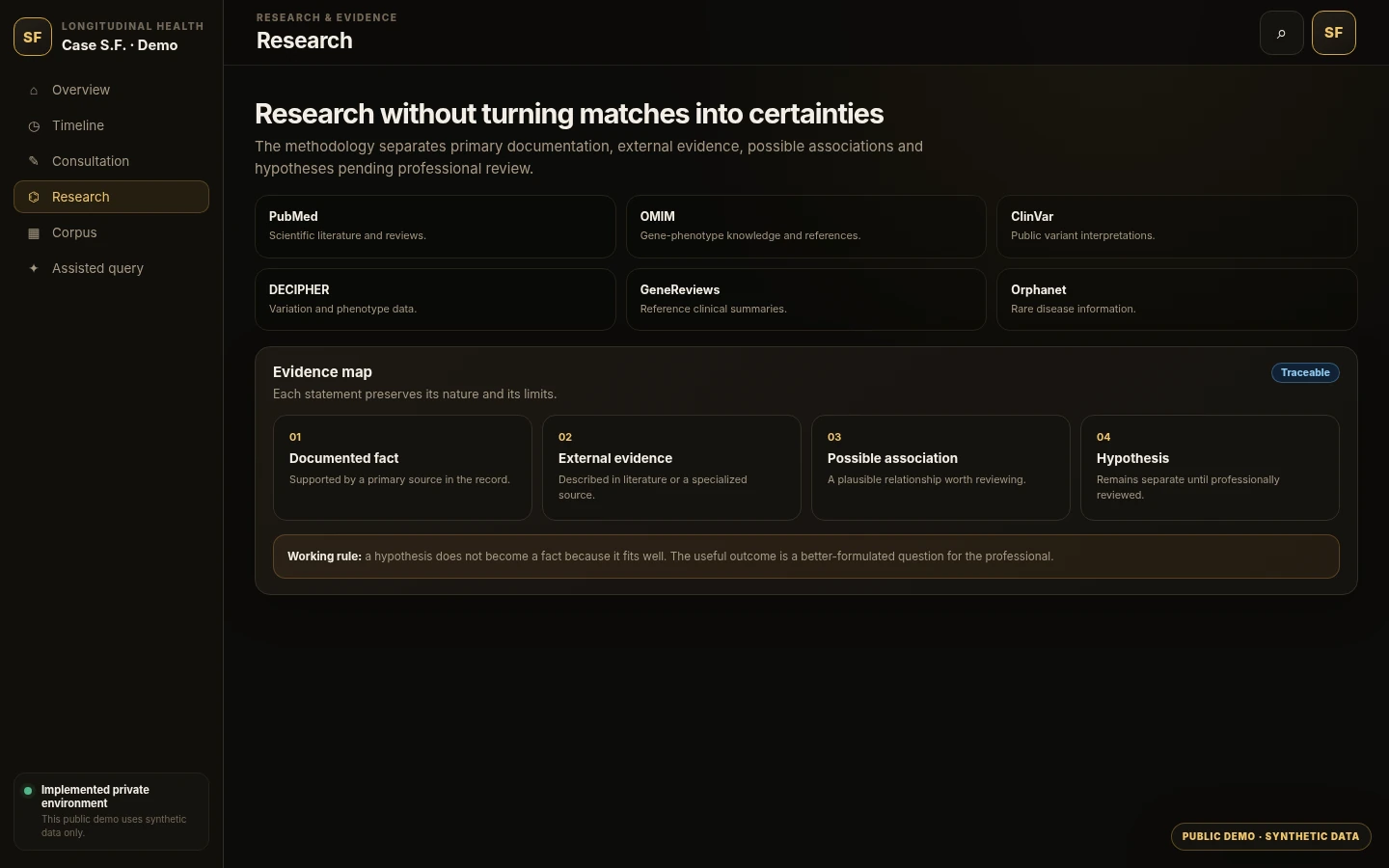
Research moved beyond the existing record and began connecting scientific literature, specialized databases, published cases and knowledge networks. The goal was not to find a convenient answer, but to understand what could be supported and with what level of confidence.
A primary source supports it.
Related literature or specialized knowledge.
A plausible connection that deserves review.
It remains separate from facts until it is professionally reviewed.
03 · FROM RESEARCH TO SYSTEM
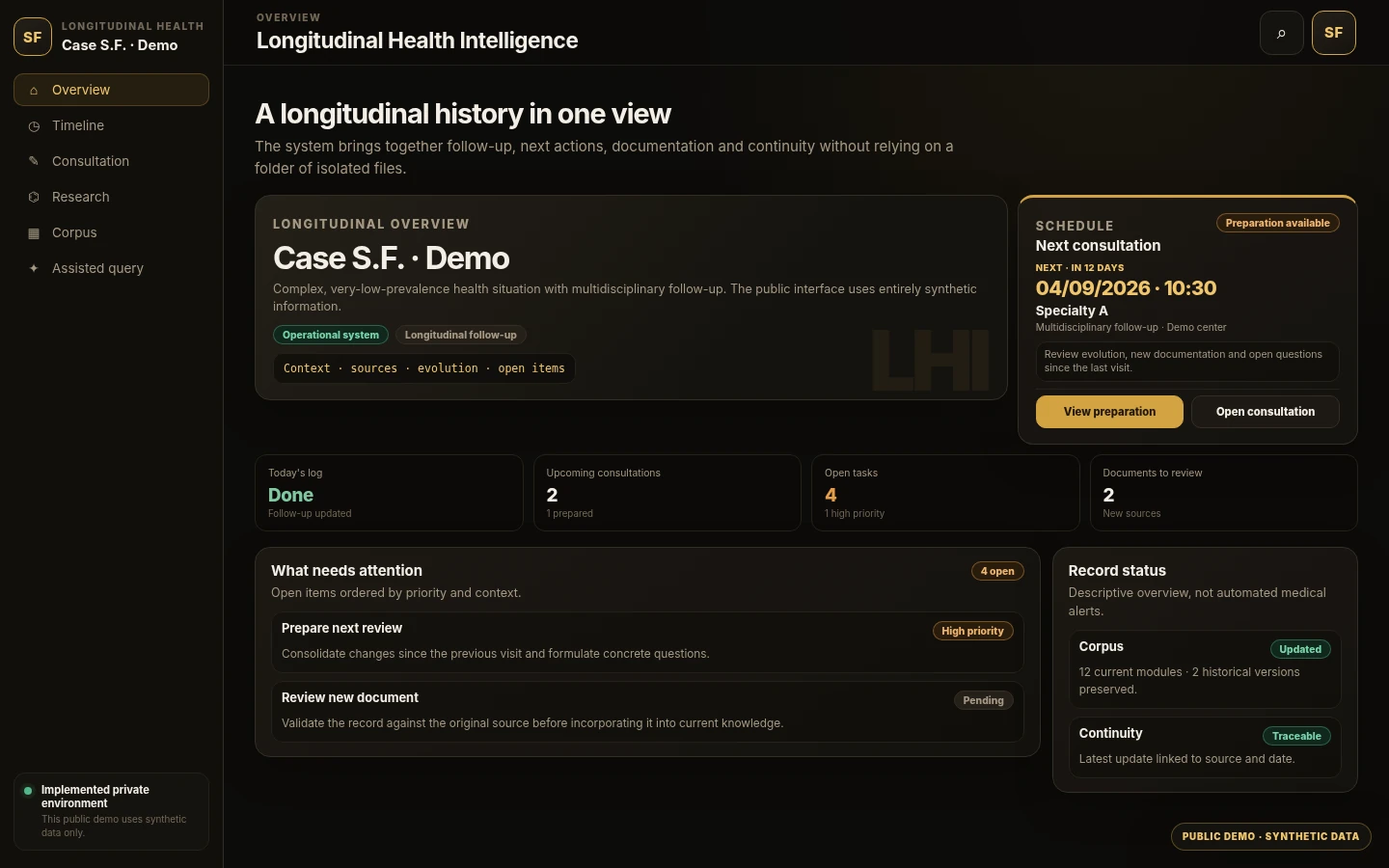
As documentation and sources grew, a second problem emerged: how to preserve what had been learned, know what remained current and connect every new piece with what came before without starting over.
04 · LONGITUDINAL KNOWLEDGE
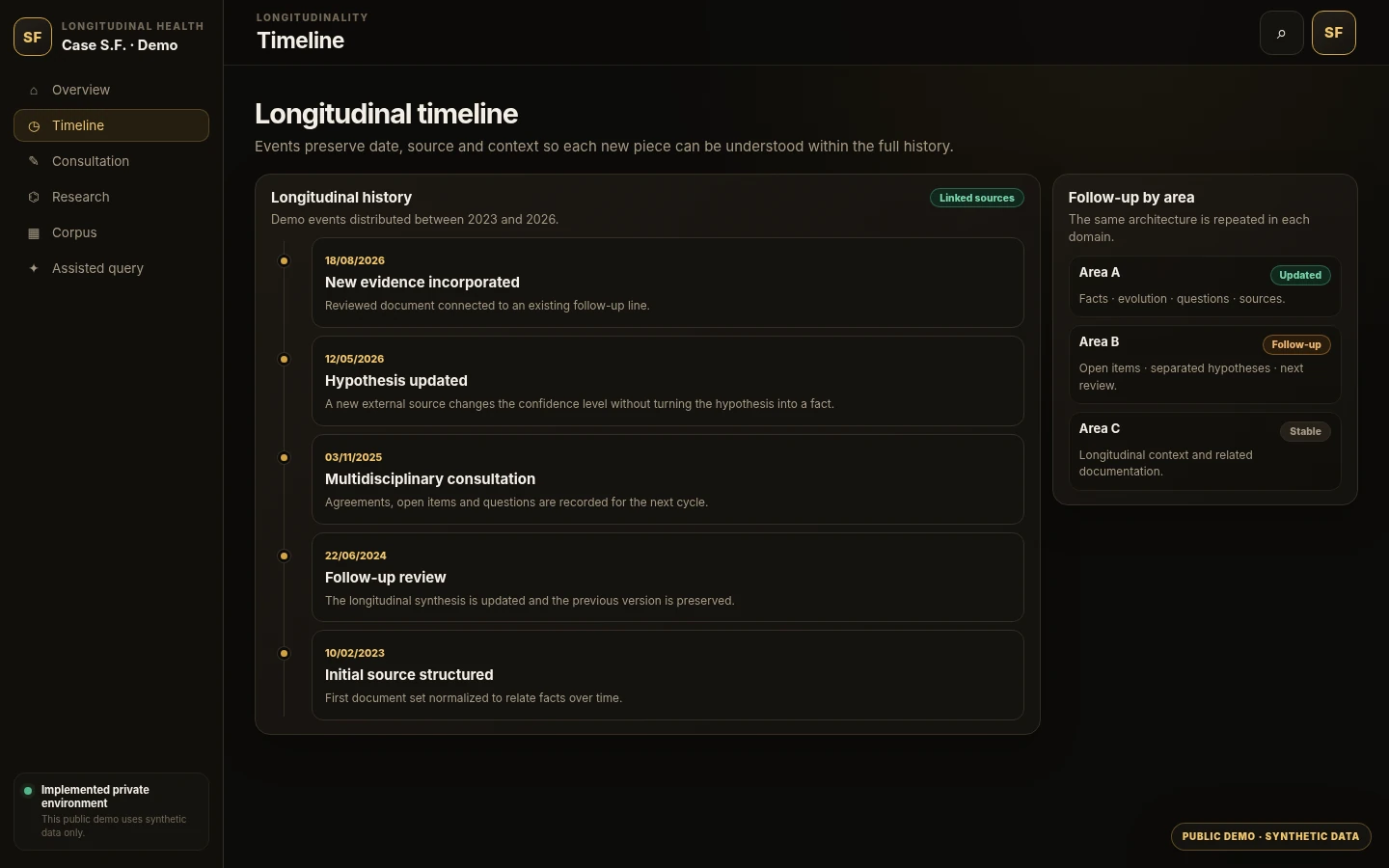
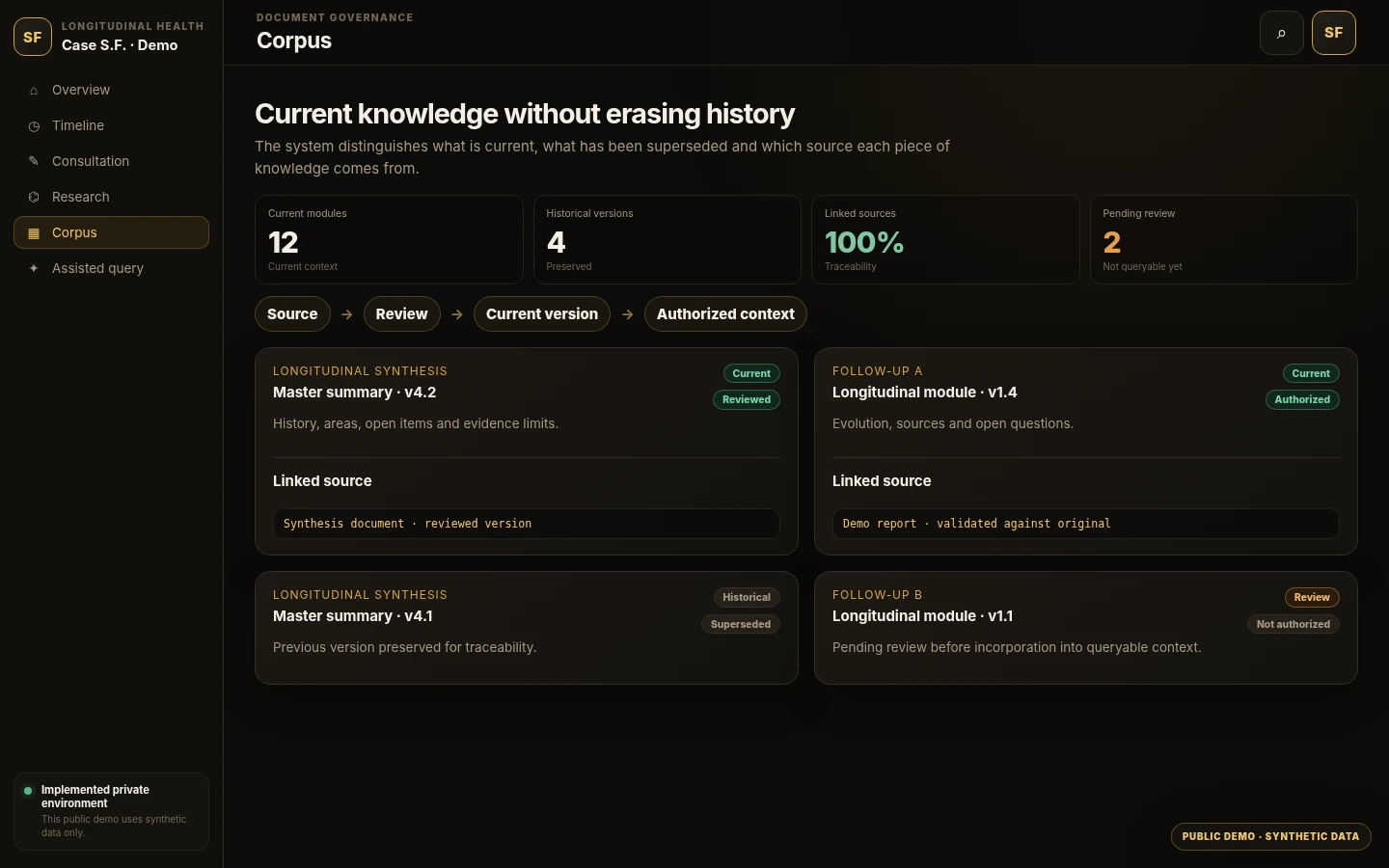
New evidence can expand, modify or supersede previous knowledge. The system needs to preserve what happened, when it happened, where it came from and why the current state differs from the previous one.
05 · FROM KNOWLEDGE TO CONSULTATION
The system creates value when knowledge can become useful context: preparing what changed, which sources are relevant and which questions deserve professional review.
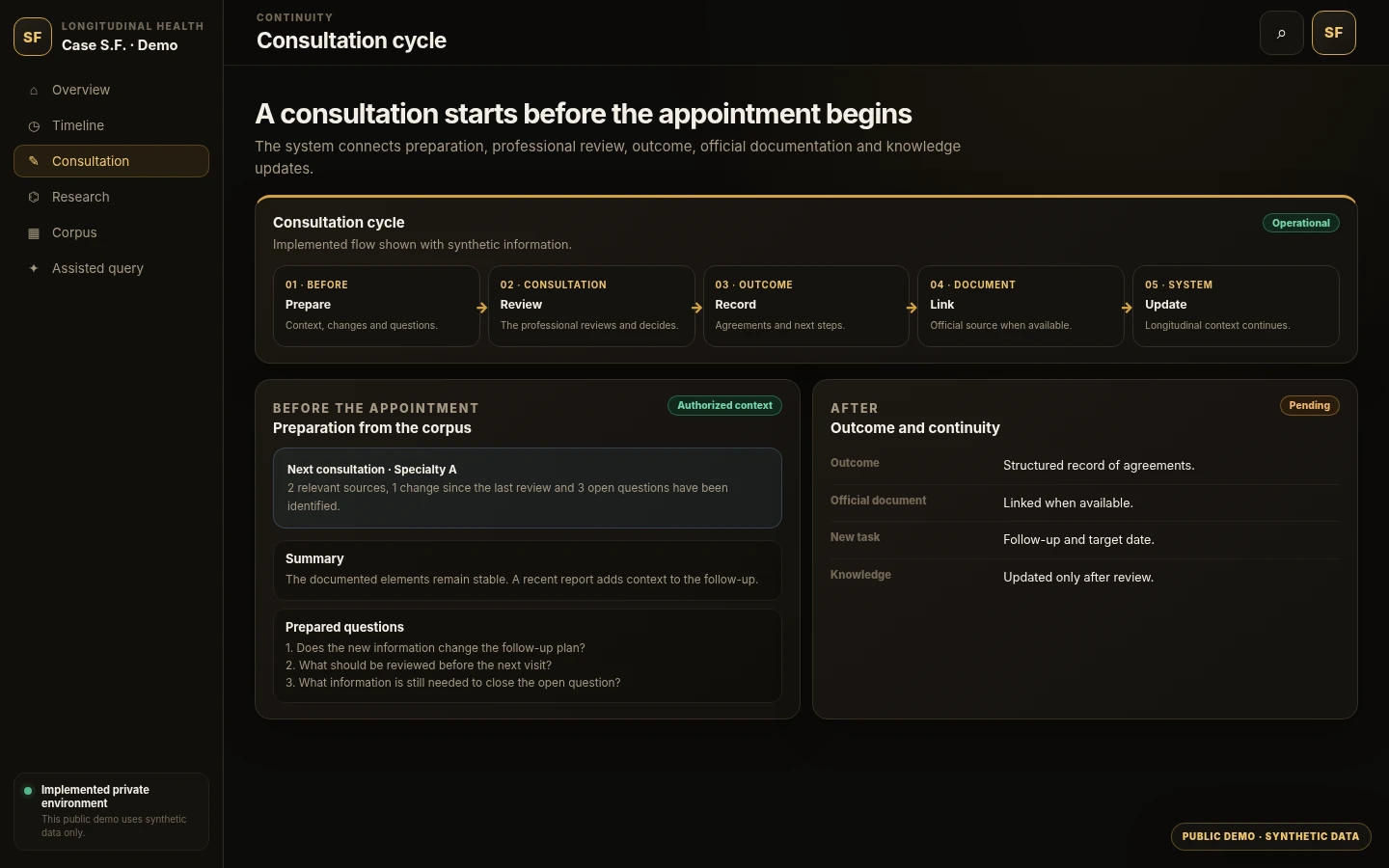
Relevant facts, sources and questions.
The professional reviews, validates, qualifies or discards.
Agreements, open items and decisions remain linked.
The new source becomes part of the continuity.
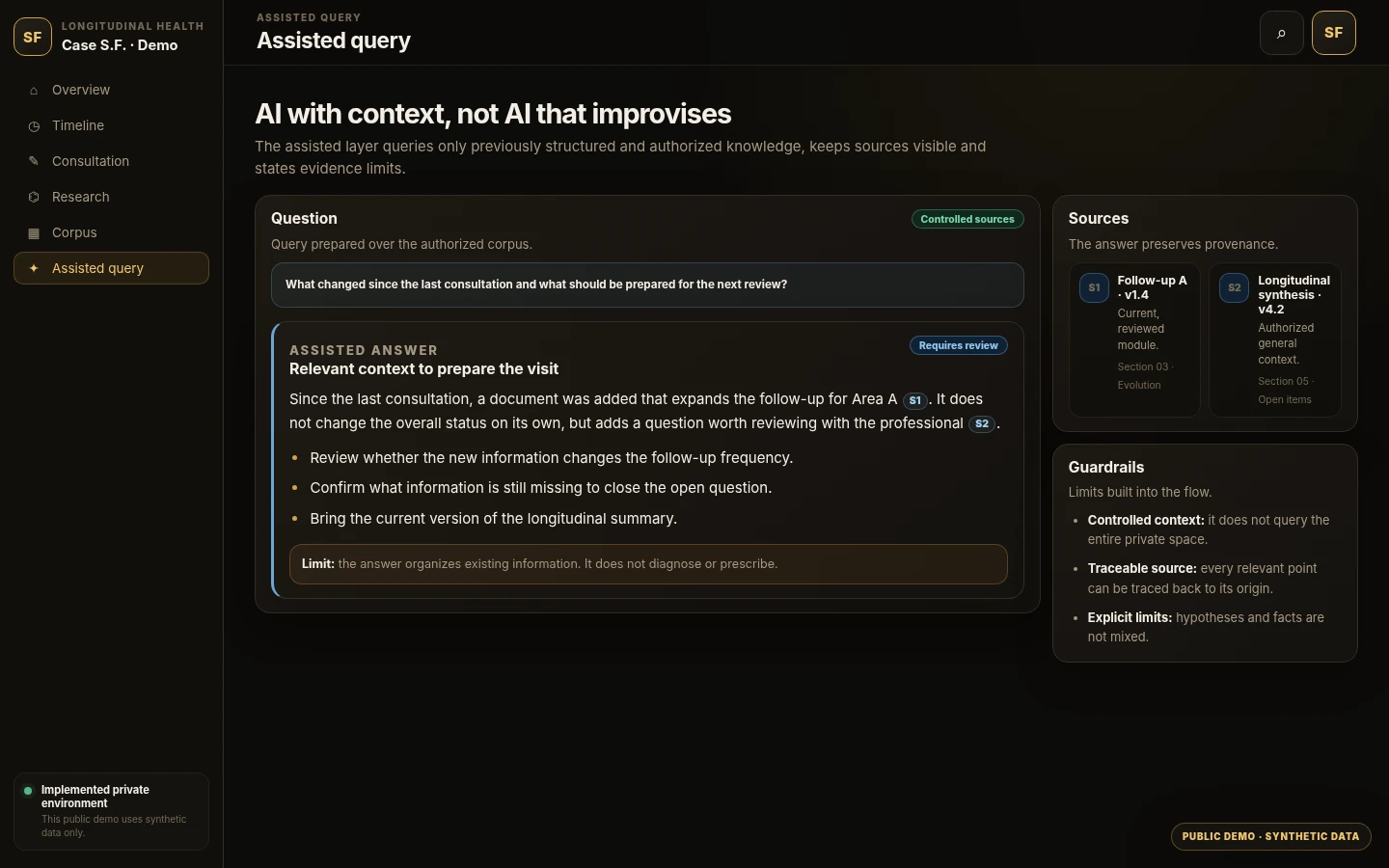
AI WITH CONTEXT, NOT AI THAT IMPROVISES
The assisted layer does not perform the original research or replace the professional. It works over previously structured and authorized content to help locate, summarize and relate information with visible sources.
Preservation and private-use records.
Reviewed sources, versions and context.
Content enabled for assisted processes.
06 · WHAT IT DEMONSTRATES
Longitudinal Health Intelligence turns a specific continuity need into a generalizable capability: researching, structuring, preserving and using complex information without losing the boundary between evidence, hypothesis and professional decision-making.
Search, compare and structure external sources with different confidence levels.
Preserve evolution, versions and context over time.
Turn real needs into usable flows and structures.
Apply contextual assistance after defining sources and limits.
Separate preservation, knowledge and authorized context through the architecture.
Design continuity across research, follow-up and everyday use.
The implementation integrates authentication, longitudinal management, documentation, follow-up, a consultation cycle, versioned corpus and an assisted layer over authorized content. It is not presented as a diagnostic tool or as a clinically validated product.
Experience opened the question. Methodology made it possible to build the answer.